When it comes to teaching multiplication in 3rd grade, no single strategy works perfectly for every student. Successful math instruction gives students multiple ways to understand multiplication so they can confidently move from equal groups and arrays to mental math and fluency.
Teaching multiplication through concept-based strategies helps students build deep number sense instead of relying on memorization alone. When students learn how multiplication works before memorizing facts, they are more successful. Below, you’ll find the most effective, teacher-approved multiplication strategies for elementary students — especially 3rd graders who are just beginning their multiplication journey. These strategies are commonly used in highly effective math classrooms
1. Equal Groups
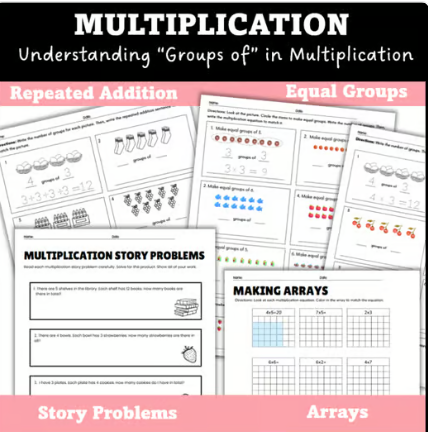
Equal groups teach students that multiplication represents groups of the same size. For example, 4 × 3 means 4 groups of 3. This helps students see multiplication as organized and fair — not random.
Hands-on tools like counters, cubes, and pictures make this strategy concrete, and once students master equal groups, every other strategy becomes easier.
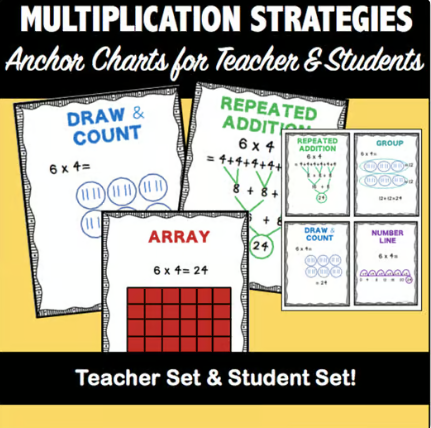
2. Repeated Addition
Repeated addition connects multiplication to familiar addition skills.
Example: 5 × 4 becomes 5 + 5 + 5 + 5.
This strategy reinforces that multiplication is a faster way to add equal amounts, helping students transition toward more efficient thinking.
3. Arrays
Arrays visually show multiplication using rows and columns.
Example: 3 rows of 6 dots
Arrays help students see patterns, understand area, and build efficiency. They also help students recognize that 3 × 6 = 6 × 3, deepening number flexibility.
4. Skip Counting
Skip counting helps students develop fluency through number patterns.
Tools include number lines, hundreds charts, and skip-count songs.
This strategy supports fact recall and prepares students for counting units in division.
5. Using Known Facts (Doubles & Near-Doubles)
Students use doubles facts (like 6 + 6 = 12 → 6 × 2 = 12) to build new multiplication knowledge.
Example for 6 × 4:
Students recognize it’s double 6 × 2.
This approach builds confidence and math flexibility.
6. Decomposing Factors (Break Apart Strategy)
Students break apart multiplication into friendly chunks:
6 × 7 = (6 × 5) + (6 × 2)
This strategy prepares students for long multiplication and algebra by helping them organize numbers into manageable pieces.
7. Number Line Multiplication
Students make equal jumps on a number line to show multiplication.
Example: 3 × 5 is three jumps of 5.
This connects multiplication to repeated addition and skip counting, deepening conceptual understanding.
Final Thoughts
When students learn why multiplication works — not just memorize times tables — they build confidence, stronger number sense, and long-term mastery.
Use these strategies alongside manipulatives, anchor charts, and daily practice to help students become flexible, confident mathematicians who understand multiplication deeply and can apply it to real-world math.